Tuesday, May 14, 2013

Biophysics Meets Old School Taxonomy! Ochre Star Pisaster ochraceus can adapt body shape to wave action!

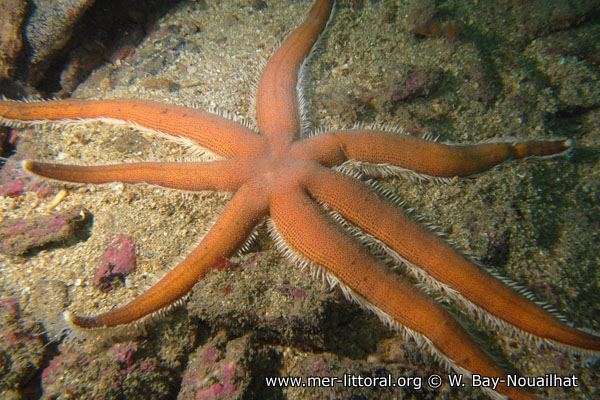
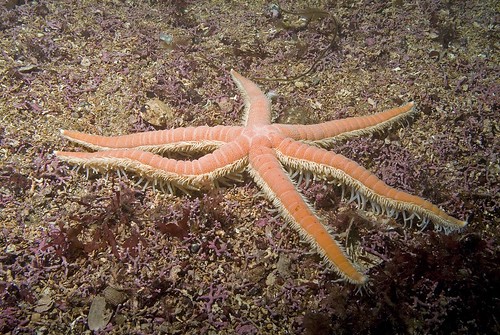
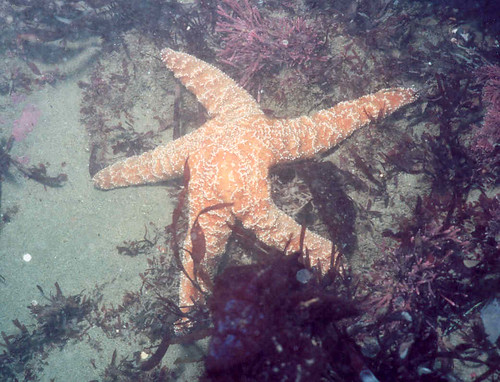
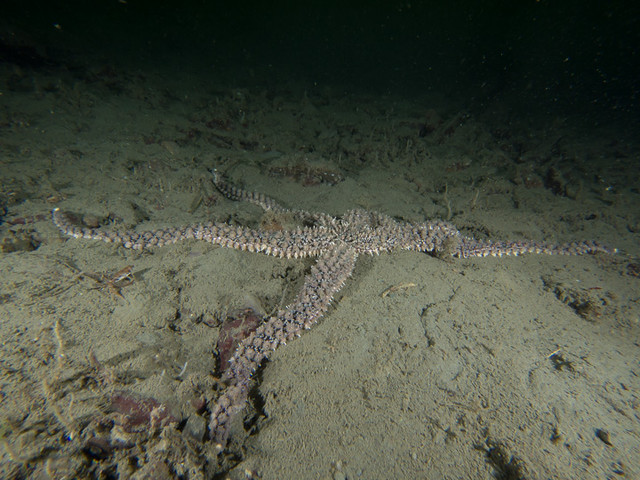
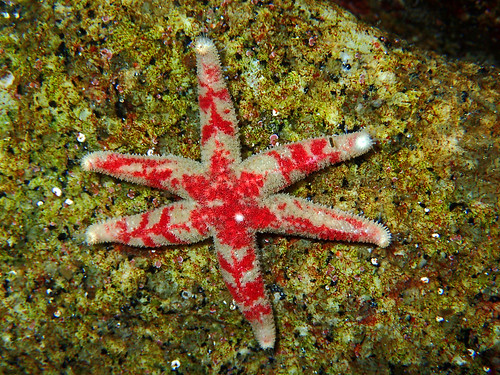
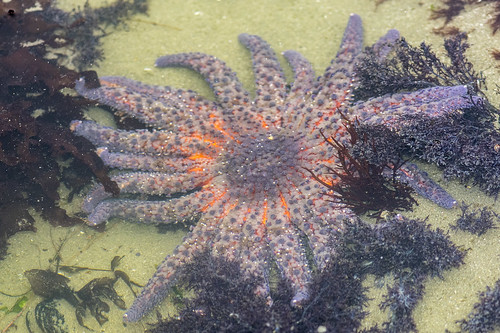
Ochre Seastar (Pisaster ochraceus) Feb 19, 2012. Patrick's Point SP., Humboldt Co., CA (1 (1)
Image by RJadams55
One of the things I love about biology is when you have an animal which has been studied down to the wire and become so familiar that people take it for granted, and then you discover something completely new about it!!!

And that in turn gives you insight into past events and other things around you. Cryptic? Yes..but I will explain.

This week's post is from Kurtis Hayne and A. Richard Palmer, University of Alberta in Edmonton
who have written a swell, new paper in the Journal of Experimental Biology 216: 1717-1725 (here)
(my thanks to Kurtis for an offprint of the paper).

It studies the reaction of the classic workhorse starfish Pisaster ochraceus as it reacts to one of the harshest of environmental stresses:  the ocean itself! WAVES!!      SPLOOSH!
Hang On!
Image by Lance and Erin Willett
Details....
Hayne and Palmer collected numerous individuals in and around Barkley Sound near the Bamfield Marine Sciences Center on Vancouver Island.  Individuals were collected and measured to assess values for drag and lift. Some were tagged and returned to the field for various field transplant experiments (look below).

Specimens were also surveyed in the field and correlated with the power of various wave forces.

Their findings!
1.  Sea stars in wave-exposed sites had narrower arms and were lighter per unit arm length than those from sheltered sites. On average, animals from the most exposed sites were 12% narrower at the base compared to the most sheltered!

2. Body form was tightly correlated with the maximum velocity of breaking waves across four different localities and over time.

3. Sea stars were transplanted between sheltered sites to more wave-exposed sites revealing that they became LIGHTER per unit arm length, developing narrower arms after 3 months! There was a tight correlation between water flow and the body shape which strongly supported the idea that wave force was affecting the body shape.

This figure 7 very nicely summarizes their findings. The animal on your left ("A") is an example of an animal from "most sheltered" going right to the one on the lower right from "most wave exposed".

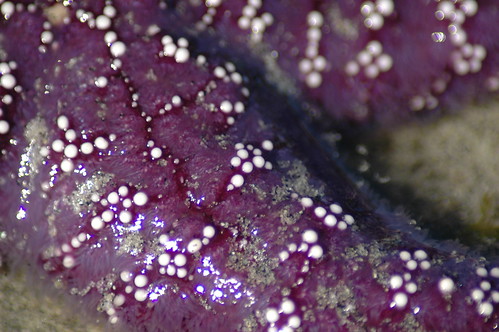
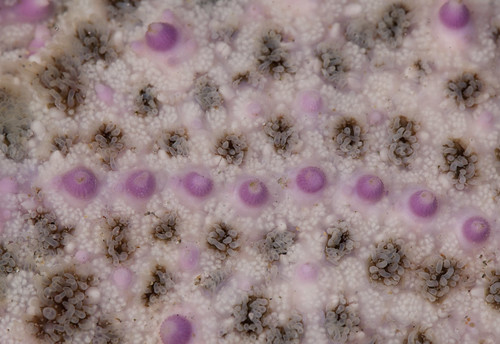
 and the small box "D" even shows the extent that the abactinal spine/granules show density and a heavier degree of calcification between a sheltered (orange on the left) vs. an exposed (purple on the right) individual.  

The exposed form below is overall smaller in size, weigh less, and with a higher aspect ratio (arms narrower, etc.) and with a more dense skeleton.   
Dynamics 
1. This is thought to aid the individuals in a wave-exposed environment from being washed away. Not as much lift and not as much drag.
2. The heavier granules offer more protection against the crashing forces of the waves.
3. BUT, having a higher aspect ratio comes with some costs:
          a. such as being more prone to overheating. Sheltered are much more effective at resisting
              overheating and water loss. Although heating may be offset by cooling temperatures from
               waves and such..
          b. having smaller areas available for gonads. This results in lower overall production of
               reproductive material and so on..

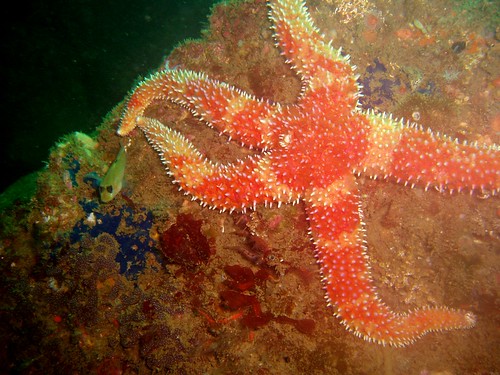
Image by jkenning
we saw more starfish on the second day

Image by Shannon Robalino
Pisaster ochraceus


The protected body form
These make more sense in protected areas away from the harsh, crashing wave-swept regions:
Some dynamics...

1. Larger animals are more likely to be caught and washed out to shore. (greater drag and lift at play)
2. BUT the larger, thicker size involves more water retention and thus better thermoregulation and better cooling.
3. Greater volume for gonads! More potential offspring!

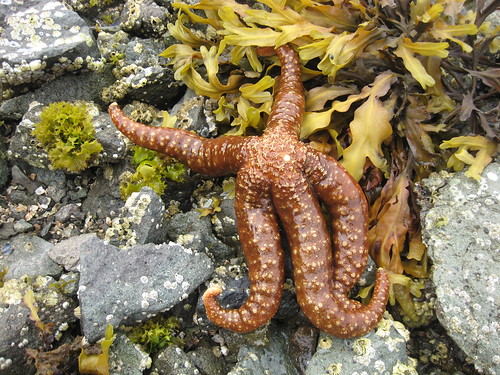
from Scenic Beach State Park in Washington
Ochre Sea Star
From Samantha Russell
Pisaster ochraceus

Bear in mind-that in order to test these interpretations, animals were actually transplanted between protected vs. wave-swept areas. Transplanted animals (from protected to the exposed wave-swept areas) decreased in mass and increased in aspect ratio over time. 

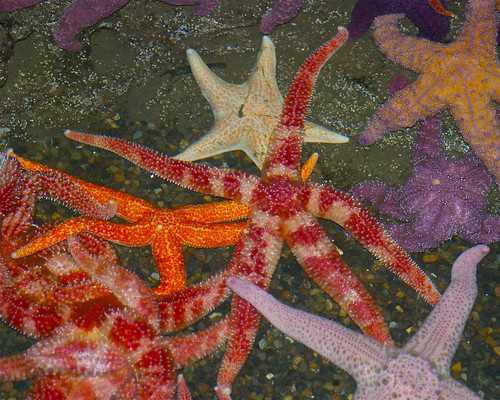
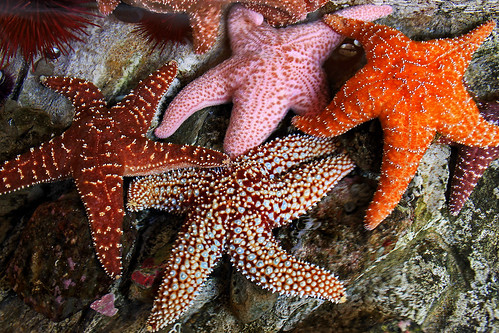
Environemntal factors directly affected the body shape of ochre stars!

Biophysics Meets old fashioned Taxonomy!
Probably the neatest footnote to all of this was that these differences in different forms of Pisaster was observed by several naturalists in California, early in the 20th Century.

The great Stanford starfish biologist and Director of the Hopkins Marine lab, Walter K. Fisher identified several "forma" or distinct morphological variants of Pisaster ochraceus in his giant 3 volume monograph documenting and describing the asteroids of the Pacific Northwest from 1930.(sadly the Asteriidae is not in the volume linked).
Fisher even observed that the differences in three of these forma seemed to be based on the degree of calcified skeleton, i.e., how built up the spines were...
It is difficult to escape the inference that the characteristic small spinelets of the abactinal area are correlated with queit water, but that this is ot the only factor is evidenced by the presence, along with confertus, of forma ochraceus and nodiferus, the latter found on open coasts and also in deep water (Monterey Bay).
The variant nodiferus is Hayne and Palmer's "exposed coast" morphological form. Fisher's comments about the inconsistency of abactinal spinelet shape/size suggest there remains even more variation and other factors to consider in future studies..

Sometimes, these "forma" turn out to be distinct taxa-perhaps subspecies or species. But sometimes its just some variation in body form in reaction to the environment.

Just as if we took a flabby, couch potato from his comfy TV room with silk bedsheets and put that person into an underground mine to dig minerals for a living. We would perhaps see changes in musculature, bone structure, and maybe even hair/eye color.

So there you have it! A cool convergence between a modern biophysics story with a fun footnote from classical taxonomy/natural history!
Are these considerations we might apply to other intertidal asteroids in similar settings? (Stichaster australis from New Zealand). Image by Jon Mollivan
JJS_0095

Want to know more about the Ochre Star: Pisaster ochraceus?
 Here's my post about Pisaster ochraceus ecology and role in climate change. 

and what explains all the color variation in Ochre Stars?? (here)

Want to see a sea urchin that lives in a high-energy wave swept environment? See Colobocentrotus! The Shingle Urchin.

Tuesday, May 7, 2013

Flatworm Color Explosion! Off topic! A Panoply of Playhelminths!

Today, here in Washington DC, we have an overcast day with a rather dreary storm raining down on us..and a quick skim through the news is filled with all kinds of blah and bad news, Sequester is the buzz of the town.. so..meh.  What to do??

FLATWORM COLOR EXPLOSION!!!!!
A striking yellow/greenish Pseudoceros dimidiatus from Osprey Reef,Coral Sea.
Pseudoceros dimidiatus
Photo by Richard Ling
A brief zoology lesson: Flatworms are members of the phylum Platyhelminthes. This is the group of worms which includes many parasitic forms, such as the tape worms and trematodes as well as several free-living species that live on land, in freshwater and in the ocean.

If you remember those funny arrow-headed ones that you could cut and via regeneration give it two or more heads? That was a flatworm!  Many, many species are found throughout the world.

Free living flatworms are mostly predatory-feeding on immovable animals, such as tunicates to other smaller animals and worms. There's a LOT of different species with many interesting biological stories! Some (go here) are mimics with nudibranchs! 

But most folks don't realize just how colorful and gorgeous they are in the tropics!  Here is a bunch....

Pseudoceros bifurcus from Kenya.
Pseudoceros bifurcus 02
Photo by Jim Anderson
Another of the same species (P. bifurucs) from Singapore apparently feeding on some tunicates.
Red-tipped flatworm (Pseudoceros bifurcus), eating Pink ascidian?
Photo by Wild Singapore
Pseudoceros laingensis from Straits of Johore
Purple-spotted flatworm (Pseudoceros laingensis)
Photo by Arthur Anker
Sorry, this one didn't have a name.. Amazing to look at though... From French Polynesia.
flatworm 2-2
Photo by Pauline Bosserelle
Another flatworm I don't have a name for.. but apparently from the Philippines
Flatworm 5608-2
Photo by "Jason" aka Jasdivr
Another one without a name.. This one from Oahu, Hawaii!
Divided Flatworm
Photo by Bill Stohler
Possibly Cycloporus sp. on its tunicate host/food (Didemnum molle) fr. Wori Bay, Sulawasi
unidentified Flatworm on the surface of a Tunicate (Didemnum molle) - Wori Bay
Photo by Christian Loader
Pseudoceros susanae?  A beauty from the Maldives!
Susan's Flatworm
Photo by Chris Dow
Another stunning Pseudoceros susanae? from the Maldives
M0024146
Photo by Philippe Guillaume
Purple flatworm! From Bali.
IMG_9482
Photo by Ben Naden
Pseudobiceros bedfordi, the so-called "Persian carpet flatworm." This one from Dayang, Malaysia
Persian Carpet Flatworm, Dayang
Photo by Dyana Wu

A neat one with a different texture! A "papillose flatworm"  Thysanozoon/Acanthozoon? From Madang, Papua New Guinea.

Cute papillose flatworm (Thyzanozoon sp / Acanthozoon sp ?)
Photo by Arthur Anker
Thysanozoon sp. from Panama.
Thysanozoon sp, Panama
Another gorgeous pic by Arthur Anker
Acanthozoon sp. from the Philippines
Acan
Photo by Eunice Khoo
and that's just the marine ones!  the land ones get even better! but I'll save those for another day....

Tuesday, April 30, 2013

Flukes in Cukes! Flatworm Commensals in Sea Cucumbers, Sea Urchins and Starfish!

DSC00523
Fantastic image by Chelsea L. Wood
Today we look at some neat examples of flatworms that live in echinoderms!

And to the flatworm and parasitic worm people reading this? YES, I know flukes aren't free-living flatworms. It rhymed! So go with it for now. thanks for your patience!

Flatworms aka the Platyhelminths (in Greek-literally the "flat worms") look like living carpets. They are mostly predatory, but may also feed on small organic particles and live all over the place. They can be parasites, such as tapeworms or free-living beasts such as the one featured in the collage below.

These include the familiar Dugesia-that you find in high school biology (brown with arrow shaped head and two weird eyes) to these big, colorful species that live throughout the tropical Atlantic and Pacific. There are some 4500 recognized species of free-living flatworms..
Polyclad flatworm collage
An awesome collage by Arthur Anker!
Papers that were used today:  this paper by George Shinn (1981)-Hydrobiologia 84: 155-162
another in Biological Bulletin 169: 182-198 (also by Shinn) and this one, from Canadian J. of Zoology 61(4): 750-760 which describes the species living in the sea cucumber

What's interesting about the ones that I'll be talking about is that none of these is exclusively parasitic (such as a tapeworm or a trematode). These are free-living species..but they live INSIDE the body cavities of echinoderms!  

Think of it as if you ended up living in the intestine or the body cavity of a whale. Lots of space there and potentially...a  lot of food. Plus protection from predators, the elements and a safe place to reproduce!

So, technically they aren't really parasites (where the host 'loses') they are commensals that are considered just kind of benign.
Image from WallaWalla University Inverts site! 
It makes sense. Sometimes, an animal with a huge internal body cavity can be a home. We've seen the classic pearlfish and even when clams that live inside the throats of sea cucumbers.

It turns out that there's something in the neighborhood of SEVENTY species of different free-living flatworms that live in echinoderms as hosts! A nice list of these can be found in this paper here.

Most of these hosts appear to be sea cucumbers with sea urchins and sea stars. Some in cold water but also in the tropics!  Crinoids and brittle stars seem to be among the minority as hosts for flatworms..probably because there's not much "living space" inside their body cavity. Or maybe they're just not as well studied?

Here are two well-documented worms from the North Pacific coast.. one that lives in several Pacific urchins and one in a North Pacific sea cucumber...

The Urchin as a "House" for flatworms! 
Urchins on the west coast of North America (in the Pacific Northwest) include the well-known purple sea urchin (Strongylocentrotus purpuratus)
Purple Sea Urchin - Strongylocentrotus pupuratus
Image by Joe McKenna
And the giant red urchin (Strongylocentrotus franciscanus)
Red Sea Urchin
Image by Dan Hershman
and the deep-sea Allocentrotus fragilis
expl1040
Image by NOAA Photo Library

ALL of these are often inhabited by this beast! Syndisyrinx franciscanus
DSC00519
Image by Chelsea L. Wood
Syndisyrinx franciscanus lives in the digestive tract of its host and apparently, infested urchins have been found with up to 186 worms!!! (an average of about 29/individual)
DSC00521
Image by Chelsea L. Wood
This one is called Syndesmis dendrastrorum 
From the EOL page for S. dendrastrorum
and it lives in the common Pacific Northwest sand dollar Dendraster excentricus!! (seen below alive with spines)
Sand Dollar (Dendraster excentricus)
Image by Patrick Warren
or perhaps more familiar if seen like this? Spines removed...
Eccentric Sand Dollar (Dead) - Dendraster excentricus
Image by Cheryl Moorehead
Even the familiar Pacific Sand Dollars can HAVE WORMS!!!  Ya' learn something new every day!
What do they do in there? Mostly, these live in the intestine feeding on the host's intestinal lining (the tissue) AND apparently also like to eat on the symbiotic protists (the ciliates) that ALSO live in the intestine of the host.  But this apparently doesn't create any detrimental effects on the host. So-commensal rather than parasitic.

Apparently, the worms produce egg capsules are released into the intestine of the host and released outside with the feces.  When the capsules are eaten by a new host, they become active.... probably a reaction to the intestinal fluid and proceed to live out their new life in the new host's intestine.

Flukes in Cukes! 
A free-living worm lives in the Pacific NW sea cucumber Parastichopus californicus.
California Sea Cucumber (Parastichopus californicus)
Image by T. Van Nunnery
This beast is called Anoplodium hymanae, a worm that is named for the famous Invertebrate Zoologist Libbie Hyman
DSC00524
Image by Chelsea L. Wood
These are a little more aggressive than the ones that live in sea urchins.

This species reaches the body cavity by penetrating the wall of the intestine..usually through the respiratory trees (feathery structures colored in blue in the pic).  I've briefly mentioned this area as where some sea cucumbers can feed via their butt!


The eggs are spread out via the anus with the feces until they are devoured by a host.

Similar to the ones in urchins, the larvae hatch in response to digestive fluids in the intestine of the host. Get into the intestine, move to the respiratory trees and then further move out into the body cavity of their new host!
DSC00523
Image by Chelsea L. Wood
Starfish got worms too!
So, there aren't a lot of records of flatworms that live in/among sea stars. Six were recorded in asteroids..and oddly enough, the one below was not included. So maybe its something new?

Description of this pic indicated the cold-temperate North Atlantic asteriid species Leptasterias littoralis. Is this a commensal flatworm moving within the tube foot groove? Moving around on the surface?  Something new? A convergence of two species by chance?
Starfish & Flat Worm
Image by Nick Sleptov
For more worm-starfish relations?

Go to this pic of Echinaster callosus and look closely at the short, striped things crawling on the swellings!    this one has a tighter shot that shows them a little more easily..note the brown squares with the white stripes.. (and includes a shrimp to boot!) WOO!  Acoel flatworms? 

How many remain to be discovered?? 

Tuesday, April 23, 2013

How many starfish species are there?? Where do they Live? How long have they been around? Five Points about Sea Star Diversity!
Images here from the Encyclopedia of Life
This week, something about the many different KINDS of asteroids (aka sea star or starfish!) that are found throughout the world. Data for this, is from a paper I wrote with Dan Blake last year for PLOS One. You can download it for free here based on info at the World Asteroidea Database.

I can't tell you how many times I've read something about starfish in pop culture or even in pop sci-and the writer assumes that starfish are the SAME all over the world! As if there was only one type.

This gets to be annoying..so let me just make sure everyone knows: There's a LOT OF DIFFERENT KINDS OF STARFISH. And they live in different places all around the world.

Similarly, I've talked about my field work in Antarctica and in the middle of my story, someone stops me to ask "Wait, there are starfish IN ANTARCTICA??"

So here are five things about the diversity of sea stars that will razzle your dazzle and make you a favorite at echinoderm-themed invertebrate zoology parties (esp. those where people are ignorant of starfish)!

1. How Many Starfish Species Are there?
At the moment? There's about 1900 species of accepted (living) starfish in the database. That runs a bit lower than the larger numbers quoted elsewhere (such as here),  but I assure you, that I am doing everything I can to kick that 1900 up a notch every chance I get!

Here's a post where I keep track of many of my new species!

More importantly, that's 1900 species in 36 FAMILIES. That means there's 36 different distinct groupings found all throughout the world in different habitats at different depths in different settings. So, its not just 1900 different kinds spread out all over the place- its 1900 species divided up into 36 distinct body types adapted to living in many different ecological niches!! (note that 1900 is a rounded figure due to questionable status for some names)

For those who need to know: the full list is in the PLOS paper listed above. So feel free to click and go!

Of the many weird kinds, there's Tremaster, as I discussed here awhile back.. 
There's the deep-sea brisingids! Crazy lookin' things that live in the deeps! Here

This Antarctic monster! Labidiaster annulatus!            The Slime Stars! Yay Mucus!

Predatory Sun Stars!     And just for good measure- here's a neat assortment from Hawaii! 

2. Where Do Starfish Live? 
All echinoderms, including sea stars, live in the ocean-on the sea bottoms (although their larvae swim in the water column). They are among the few groups of animals which live exclusively in marine habitats.

Starfish live in all the oceans! Atlantic! Pacific! Indian! Arctic! Southern!

And in answer to the question "Do starfish live in Antarctica?" and "Under the Ice?"  Yes!

The video below is from the famous "brinicle" video released awhile back showing starfish (Odontaster validus, probably) getting around some hardcore Antarctic ice! (narrated by 30 Rock celebrity Alex Baldwin!)

And many starfish also live in the deep-sea (below 200m).

Of the 36 living families of sea stars, nineteen of them occur exclusively in the deep-sea (436 species)! Four families are mostly deep sea but with some shallow-water members (1191 species) and several families include large numbers of deep-sea members. Only 8 families live ONLY in tropical habitats (218 species).
 It turns out that MOST starfish live in cold-water (or temperate) settings, such as the deep-sea or in the polar or near polar regions!

So among those deep-sea starfish species, which ones live most deeply?  As it turns out several starfish groups occur in the deep abyss below 5000 meters!

One of the most commonly encountered deep-sea asteroid groups at that depth is the Porcellanasteridae.
Image from the EOL page
They usually live buried in mud, devouring massive amounts of sediment, presumably absorbing digesting various goodies present in it.  This feeding mode is similar to the more shallow-water mud stars, which I profiled here.

Another group known to occur down to 6000 meters? Brisingids (go here to learn more) in the family Freyellidae...

Easily half a dozen families of asteroids are represented at the 5000+ meter depth range! Its unclear how many go deeper than 6000 however...

3. Which Group of Sea Stars is Most Diverse? (i.e., Which one has the most species?)
What's weird about this question is that the group with the MOST number of species is probably the group you are least familiar with...  Enter:  The Goniasteridae! 

Ding!Ding! This group rings in at a whopping 256 species in 65 genera! Deep sea! Tropical! Antarctic! Shallow! Goniasterids are everywhere (but mostly in cold-water places, in the deep sea)! 

But usually, in out of the way places, so they don't really turn up in places where people encounter them. So not many folks think of them you ask  "what does a starfish look like?"

Goniasterids vary in size and shape as you can see.. but some get REALLY large! Such as this monstrous Mariaster giganteus from Japan !!   (held by my colleague Yoichi Kogure!)

Goniasterids are diverse-and there remain MANY different species yet to be discovered....They are ecologically important in deep-sea AND shallow waters.

I'll probably do a full post on this group at some point-but in the mean time here's a bunch so far!
Tosia-the biscuit star: hidden species and brooding behavior! here!

New genera and species of deep-sea corallivores! here!  and some video!


4. How Many Undescribed Starfish Remain to be found? 
P1010709.JPG
Image by Island_girl
Its hard to make estimates about stuff that doesn't exist yet!  How many more species are out there to be discovered?  What is my best estimate???

Sea stars/starfish are big, obvious creatures. One would think that we have found most of them...but you'd be wrong!

One subject group: The Goniasteride has 256 species in 65 genera. Out of the total # of genera and species:  14% (approx n=9) of genera  and 12% (approx n=31) of species were discovered ONLY recently (since 2001).

I have further unpublished data on many MORE new goniasterids! Which suggests that the total number of newly discovered genera could go up to 37% and the number of new species could go up to 32%!!

These are rough estimates from one group. Most people might expect that new species would be found in inaccessible and poorly studied places such as the deep-sea or perhaps in distant tropical lands such as New Caledonia.  But another possible source may already be right in front of us....

Cryptic species are those which are distinguished by genetics or reproductive differences, some other source of evidence OTHER than external morphological characteristics to demonstrate they are separate species. Molecular genetics shows great potential as a tool to discover diversity where cryptic species are concerned...

Again, the case of Tosia-the biscuit star: hidden species and brooding behavior! here! is a great example.


5.  How Long Have We Observed Starfish in the Fossil Record? 
Hudsonaster USNM 40882, early asteroid from the Ordovician.  Copyright Dan Blake. Image via www.tol.org/Asteroideahttp://tolweb.org/Asteroidea
Starfish are old. And their history will doubtlessly fill another post on the Echinoblog some day. A general account of the fossil history of the Asteroidea can be found here.  But the short version is this..

Some very early ancient forms (i.e., predecessors to modern day "proper" asteroids) are observed in the Paleozoic (540 to 250 million years ago!).

But we really don't start to see modern asteroids until the Mesozoic, that is early Triassic....where the record is poorly preserved...
Left to right: Trichasteropsis weissmanni (specs. MHI 843/1, SMNS 3173/5 and Noriaster barberoi (MPUM 8420) on far right. Images copyright Dan Blake, Images via www.tol.org/Asteroidea
But basically, from then on, ALL modern asteroids continue on to the Recent. In other words, starfish which are alive today are part of the same lineage which has been around since the Triassic (250 to 200 million years ago). A distinct, separate lineage from those in the very, much older Paleozoic. 

But just to give everyone a "landmark" to gauge what I'm talking about:  YES. Starfish are OLDER than dinosaurs. 

Some starfish deposits from the Cretaceous are very well preserved and so, when T. rex was running around, starfish were there, doing their thing.  Thanks to some excellent fossil preservation, we know that some of them looked like this...

Metopaster parkinsoni
Fr. Discovering Fossils UK
Also M. parkinsoni, I believe...
Calliderma schulzei
Calliderma Schulzei
Image by Claire H
But, fossil goniasterids were highly diverse and the number of fossil species is very high. The actual number of fossil "species" is difficult to compare with living species owing to differences in what geologists called "species" versus what biologists observed in living animals. Uh.. trust me, its complex and I'll get into it another day.

But yes. Starfish have been around for quite a long time. Longer than humans (and primates). Longer than dinosaurs. 

To sum up this week?
  1. There are about 1900 species of starfish and that number is climbing.
  2. They live everywhere in the ocean! Especially in cold-water habitats like the deep-sea!
  3. The family Goniasteridae is the MOST diverse (i.e. most number of species)
  4. MANY more species of asteroids remain to be discovered!
  5. The fossil record shows that starfish have been around for a LONG time, since before big reptiles roamed the Earth!